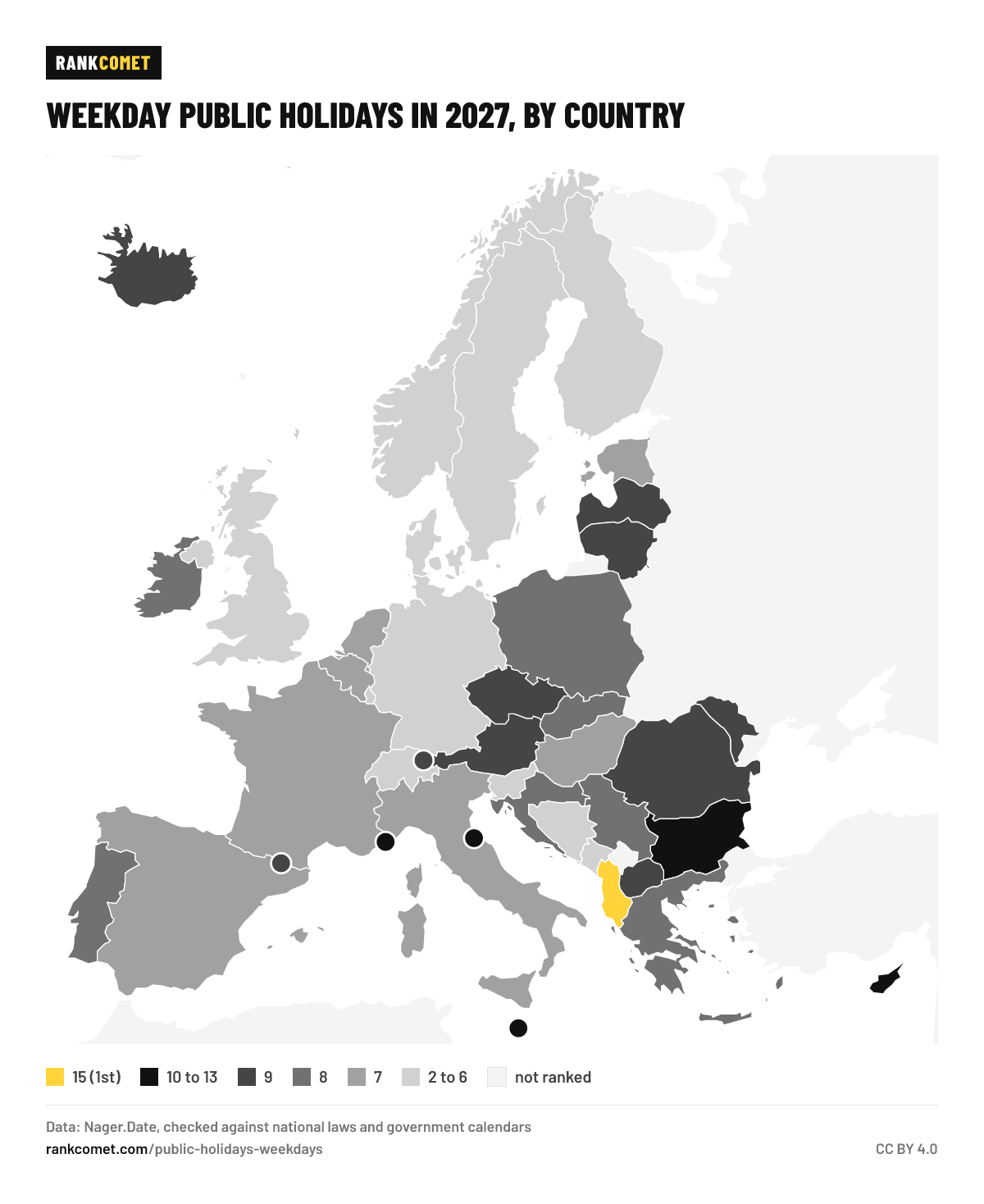
Albania gets the most public holidays on weekdays in Europe in 2027, with 15, while Switzerland and Bosnia and Herzegovina get only 2. Across the 41 countries we checked, the average is 7.9 and the median 8. Saturdays take a heavy toll this year: Labour Day on 1 May and Christmas Day both fall on one.
Each column counts the countries with that many public holidays from Monday to Friday. In black, Albania’s 15. Source: our ranking of 41 countries
Ten countries get 9, the most common count, and only three get more than 11.
Why Albania comes first
Albania’s labour code moves any public holiday that falls on a weekend to the next working day. In 2027, 9 of its 15 weekday holidays are substitutes, from Monday 4 January to Monday 27 December. Its calendar is also long to begin with: Catholic Easter, Orthodox Easter, both Eids and Nowruz are all public holidays.
San Marino comes second with 13. It has 18 public holidays in total, including the two investitures of its Captains Regent on 1 April and 1 October. Bulgaria is third with 12, thanks to the same substitution rule as Albania: Christmas Day and the day after fall on a Saturday and a Sunday, so Bulgarians get Monday 27 and Tuesday 28 December off.
Moving weekend holidays: who does it and who does not
Some countries write the substitute date into law or into the official calendar, and those dates count in this ranking. Monaco moves Assumption Day to Monday 16 August, which brings it to 10. Serbia and Montenegro move holidays that fall on a Sunday to the next working day.
Others leave the replacement to employers, so it does not show up as a date. Belgium is the clearest case: a holiday that falls on a Sunday or a usual day off must be replaced by another day off, so Belgian employees keep all 10 of their holidays even though only 7 fall on weekdays. Luxembourg and Malta grant extra days off in a similar way.
United Kingdom and Ireland
The United Kingdom gets 6 weekday bank holidays shared by its four nations, including Monday 27 and Tuesday 28 December, which replace Christmas Day and Boxing Day. England and Wales alone get 8, with Easter Monday on 29 March and the summer bank holiday on 30 August. Scotland gets 9 and Northern Ireland 10.
Ireland gets 8: New Year’s Day, St Brigid’s Day on 1 February, St Patrick’s Day, Easter Monday and four Monday holidays in May, June, August and October. Christmas Day and St Stephen’s Day fall on the weekend, and Irish law gives no automatic day off in exchange: the employer chooses between a paid day off within a month, an extra day of annual leave or an extra day’s pay.
Germany and Switzerland: holidays set by regions
Germany gets 5, because only the 9 holidays shared by all 16 federal states count here. Each state adds its own, Bavaria more than most. Switzerland goes further: only 1 August is a federal holiday, and it falls on a Sunday in 2027. New Year’s Day and Ascension are the only holidays that all 26 cantons share on a weekday, which leaves Switzerland last with 2.
Public holiday or day off: what this ranking counts
This ranking counts official public holidays, not guaranteed days off. The gap can be real. In the Netherlands, Liberation Day on 5 May is a statutory holiday, yet many collective agreements grant the day only every five years, next in 2030. In Greece, the official state list gives 8 weekday holidays, while private employers must only give 5. In Cyprus, Christmas Eve is on the official list and closes public services, but banks stay open: without it, Cyprus would get 10 instead of 11.
Hungary could gain one: bill T/714, still under debate on 23 October 2026, would make Christmas Eve a public holiday, and it falls on a Friday in 2027.

 #1

 #1

 #1