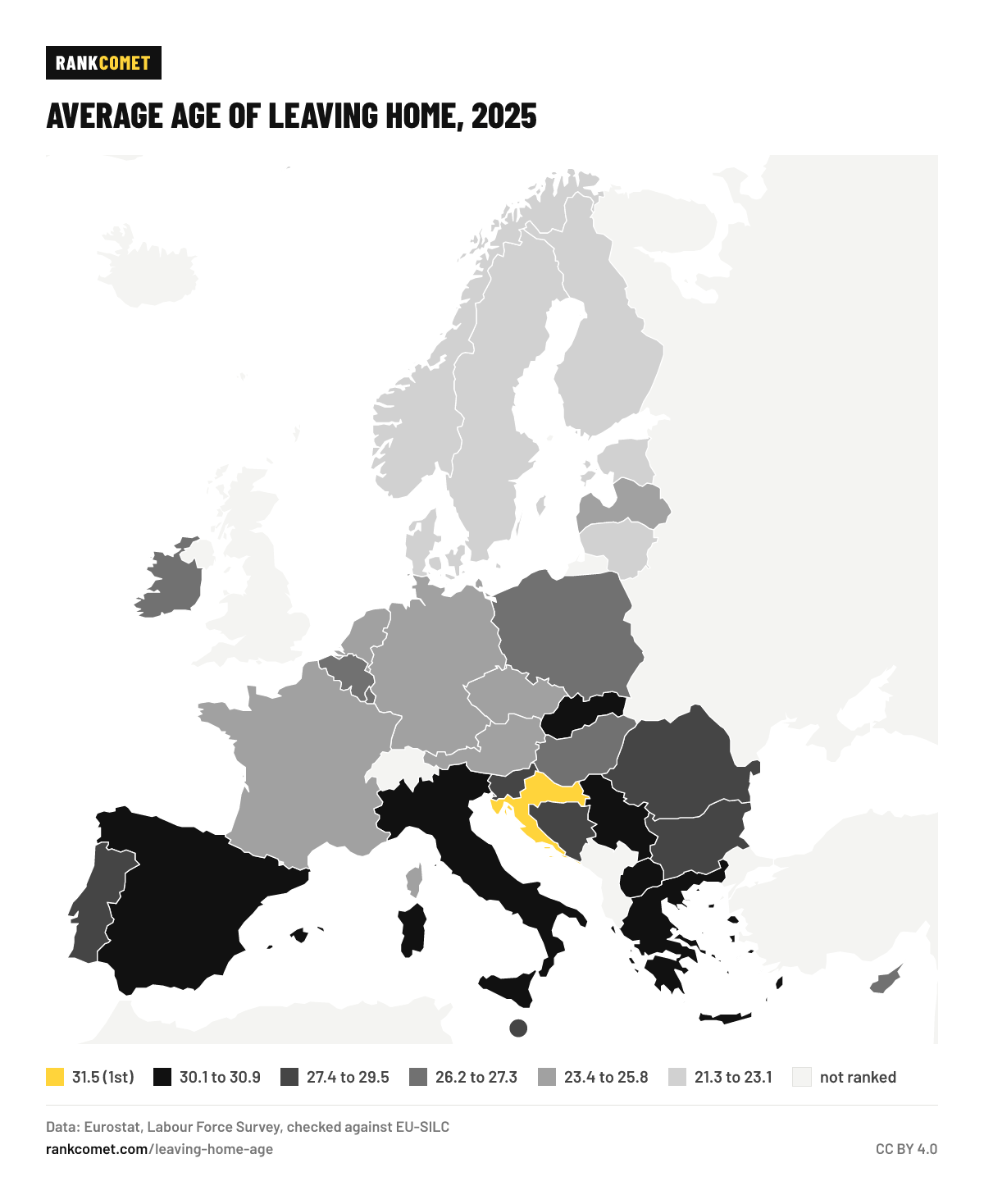
Average age of leaving home in Europe in 2025: 31 countries ranked
Young Croatians leave their parents’ home at 31.5 on average, the latest in Europe. Finns leave at 21.3, ten years earlier. We ranked Eurostat’s 2025 estimates for 31 countries and checked them against a second EU survey.
Copy this code into your page. The image updates with the ranking. Please keep the link to the source.
<a href="https://rankcomet.com/leaving-home-age/"><img src="https://rankcomet.com/map/en/leaving-home-age.png" width="1200" height="1468" alt="Map of Europe: average age of leaving home, 2025" loading="lazy"></a>
<p>Source: <a href="https://rankcomet.com/leaving-home-age/">Rankcomet</a>, CC BY 4.0</p>
Young people in Croatia leave their parents’ home at 31.5 on average, the latest of 31 European countries. Greece and Slovakia follow at 30.9, then North Macedonia at 30.7. In Finland, young people leave at 21.3, ten years earlier than in Croatia, and the EU average is 26.3.
The figures are Eurostat’s estimates for 2025, based on the Labour Force Survey.
Seven countries past 30
Croatia, Greece, Slovakia, North Macedonia, Italy, Spain and Serbia all have a leaving age of 30 or more. The lowest ages are in the four Nordic countries of the ranking, all under 23.2, and in Estonia and Lithuania (22.7).
A second survey, EU-SILC, tells the same story in another way. In Croatia, 62.3% of people aged 25 to 34 still live with their parents, against 3.9% in Denmark.
Men leave later in 30 of 31 countries
Across the EU, men leave home at 27.2 on average and women at 25.5. The gap is widest in North Macedonia, where men leave at 33.6 and women at 27.6.
Gap in leaving age between men and women, 2025
EU 1.7
North Macedonia6.0
Romania4.1
Bosnia and Herzegovina4.0
Serbia3.8
Bulgaria3.7
Croatia2.8
Greece2.8
Czechia2.8
Latvia2.8
Slovakia2.7
Slovenia2.5
Hungary2.3
Poland2.2
Cyprus1.7
Austria1.7
France1.7
Italy1.6
Portugal1.5
Germany1.5
Norway1.5
Belgium1.3
Lithuania1.3
Spain1.2
Ireland1.1
Estonia1.1
Finland1.1
Netherlands1.0
Sweden0.9
Luxembourg0.6
Denmark0.5
Malta−0.5
Men’s average leaving age minus women’s, in years. Source: Eurostat, Labour Force Survey
In this survey, Malta is the only exception, with women leaving at 27.8, half a year after men (27.3). EU-SILC finds the opposite there, with more men than women aged 25 to 34 living with their parents (39.7% against 33.5%). In the 28 other countries both surveys cover, they point the same way.
Poland does not fit the pattern
Poland’s leaving age, 26.8, is close to the EU average and ranks 17th. Yet 51.0% of Poles aged 25 to 34 live with their parents, the 5th highest share of the 29 countries EU-SILC covers. The two surveys disagree on no other country by as much.
France and its neighbours
Young people in France leave home at 23.8, 24th of 31 and 2.5 years before the EU average. Men leave at 24.6, women at 22.9. Germany is close, at 24.1, while Belgium (26.2) sits near the EU average and Italy and Spain both reach 30.2.
Only 14.8% of French 25 to 34-year-olds live with their parents, half the EU figure of 30.1%.
Key figures
years in Croatia, the latest of 31 countries
31.5
years in Finland, the earliest
21.3
years on average across the EU
26.3
years between men and women in North Macedonia, the widest gap
6.0
Share
How we calculated this
Scope: the countries of our European scope (the member states of the Council of Europe that the UN M49 standard places in Europe, plus Cyprus) for which Eurostat gives a 2025 figure: the 27 EU member states, Norway, North Macedonia, Serbia, and Bosnia and Herzegovina. The United Kingdom, Switzerland and Iceland have no 2025 figure. Source: Eurostat, dataset yth_demo_030, “estimated average age of young people leaving the parental household”, an estimate based on the EU Labour Force Survey, 2025 figures updated on 16 April 2026 and downloaded on 26 October 2026. The ranking uses the figure for men and women together; countries with the same age share a rank. The series has breaks: Portugal’s figure falls from 33.3 in 2021 to 28.8 in 2025, so we do not compare years. Check: EU-SILC, a separate survey, gives the share of 25 to 34-year-olds living with their parents in 2025 (dataset ilc_lvps08, updated on 20 October 2026). Over the 29 countries both surveys cover, the two put countries in much the same order (Spearman rank correlation of 0.93). Poland and Lithuania differ most: Poland is 17th on leaving age but has the 5th highest share of 25 to 34-year-olds living with their parents. The CSV adds the ages for men and women and the EU-SILC share.
Rankcomet (2026). Average age of leaving home in Europe in 2025: 31 countries ranked. Updated October 26, 2026. https://rankcomet.com/leaving-home-age/
On 31 January 2025, Slovenia held 1,804 inmates for 1,346 prison places, the most crowded prisons of 41 European countries. France came second at 130.8%. We worked out every country’s density from the Council of Europe’s penal statistics and checked them against national prison data.
People in Luxembourg live 24.6 years on average after they stop working, the longest of the 38 OECD countries. France follows with 24.3 years and Mexico comes last with 16.5. We ranked the OECD’s figures for 2024 and checked them against national life tables.
On 21 December 2026, Reykjavík gets 4 h 07 min of daylight and Nicosia 9 h 47 min. We calculated sunrise and sunset in 42 European capitals and checked every time against the US Naval Observatory.

 #1

 #1

 #1